Rise and Fall Are but a Dream: The Tang Empire and the Last Persian Prince
Outside the Vermilion Bird Gate of the Qianling Mausoleum in present-day Xi’an, China, stand sixty-one headless stone statues—the famous “Statues of the Sixty-One Foreign Vassals.” On the pedestal of one statue is carved a fragmentary inscription: “Peroz, King of Persia.”
Who was this Peroz? He was a prince of the Sasanian Persian dynasty (the Sasanian Empire)—in fact, the third-to-last prince of that royal house. Why, then, does the name of a Persian prince appear in Chang’an, immortalized in stone?
Persia before Islam
Unlike today’s Iran, whose predominant faith is Islam, the Sasanian Empire at that time primarily followed Zoroastrianism, commonly known as the “fire-worshipping” religion. From around the seventh century CE, however, the Sasanian Empire in West Asia suffered successive defeats under the advance of Arab Muslim armies.
In 631, Arab forces captured Qadisiyyah in the Battle of al-Qadisiyyah. From that point on, the Persians steadily lost ground. Twenty years later, in 651, the last Sasanian king, Yazdegerd III, was killed while fleeing in a mill near the city of Merv, close to the Amu Darya in Central Asia. The Sasanian dynasty, which had endured for four centuries, formally came to an end. At that time, the last Persian prince, Peroz III, led the remaining followers eastward in retreat.
Peroz and his father repeatedly sought military assistance from the Tang dynasty. Emperor Taizong of Tang, Li Shimin, declined to send troops directly, citing the great distance involved. Nevertheless, the Tang court did not entirely stand aside. In 655, Arab envoys even arrived in Chang’an, requesting that the Tang Empire refrain from intervening in Persian affairs.
According to the Zizhi Tongjian (yes, the work compiled by Sima Guang), in Volume 200, “Annals of Tang, Part 16,” covering the reigns from Yonghui to Longshuo under Emperor Gaozong, in 661 the Tang court established the “Persian Commandery” in former Persian territories (around today’s Afghanistan). Peroz was appointed its governor, symbolically incorporating Persia into the Tang imperial map. In a sense, this marked the closest moment Peroz ever came to restoring his lost kingdom.
The New Book of Tang, compiled by Ouyang Xiu, records this as follows:
“In the first year of Longshuo (661), Wang Mingyuan, magistrate south of Longzhou, was appointed commissioner for establishing prefectures and counties along the Tokharistan route. From Khotan westward and east of Persia, sixteen states were organized, with their royal capitals designated as commanderies and their subordinate tribes as prefectures and counties. In total, there were eighty-eight prefectures, one hundred and ten counties, and one hundred and twenty-six military and administrative offices.”
At the time, these commanderies were all subordinate to the Anxi Protectorate General. The Tang court’s enfeoffment of the Tokharistan states—especially the remnants of the Sasanian forces—was likely intended to support them against the expanding Arab Empire. The Persian Commandery, where the prince resided, was located at Jiling City, in eastern Iran near today’s Afghan border, around present-day Zabol.
From Persian Prince to Exile in Chang’an
The expansion of the Arab Empire proved unstoppable. Between 670 and 674, Peroz was again defeated. He eventually led his followers on a long journey east and arrived in the Tang capital, Chang’an.
The New Book of Tang records:
“Though he could not restore his state, during the Xianheng era he still came to court, was granted the post of General of the Right Guard, and died. Earlier, his son Narsieh had been taken as a hostage.”
In other words, Emperor Gaozong of Tang treated him with great honor, appointing him General of the Right Martial Guard. It was likely around this time that Persian temples—later known as Nestorian churches—were widely established in Chang’an, allowing Persian exiles to preserve their faith (though these were designated as Nestorian temples rather than Zoroastrian ones).
Peroz spent most of his remaining years in Chang’an. Once the heir to an empire, he had retreated from the western end of the Silk Road all the way to its eastern terminus. Amid the bustling streets of Chang’an—filled with whirling dances and luminous cups—he watched his country and faith fade into the dust of history.
Pei Xingjian and Narsieh: The Last Effort of the Persian Empire
After Peroz’s death, his son Narsieh inherited his father’s unfulfilled ambition. In 679, the Tang dynasty dispatched the famed general Pei Xingjian to escort Narsieh westward. (The Old Book of Tang claims that the escort was for Peroz, but Pei Xingjian’s biography states that Peroz was already dead by then. Here, the interpretation of the New Book of Tang is followed: it was Narsieh who was escorted.)
Who was Pei Xingjian? Since the Han dynasty, the Pei clan of Hedong had been a renowned aristocratic family. From the late Eastern Han onward, they were a great lineage, and during the Wei and Jin periods were famously paired with the Wang clan of Langya as the “Eight Peis and Eight Wangs.” Pei Xingjian belonged to the Zhongjuan branch of the Hedong Peis. His great-grandfather, Pei Bofeng, had served as a Cavalry General under the Northern Zhou—a pedigree of the highest prestige.
Pei Xingjian was not only of noble birth but also trained under a great master: the Tang general Su Dingfang. Su Dingfang was a celebrated commander of the late Sui and early Tang periods, who campaigned repeatedly against the Western Turkic Khaganate, fought major battles with Tibetan forces, and later served as a leading general in Tang campaigns against Baekje and Goguryeo. Pei Xingjian therefore possessed deep experience in long-distance expeditionary warfare.
Later generations regarded Pei Xingjian as both a civil and military talent. He was acquainted with leading literary figures of the time, such as Luo Binwang, Lu Zhaolin, Wang Bo, and Yang Jiong. He later authored military writings on camps, formations, and troop organization, compiled literary collections, and even created thousands of characters in cursive script.
As for the Persian prince Narsieh, he hoped to restore his kingdom with Tang military support, and Pei Xingjian was a crucial ally. However, the true strategic objective of Pei’s expedition was to pacify the Western Turks. Once this goal was achieved midway, the Tang forces withdrew. Pei Xingjian’s later career focused mainly on campaigns against Turkic powers, and he trained several future Tang generals, including Xue Ne, the eldest son of Xue Rengui.
A Prelude to the Battle of Talas
According to the New Book of Tang, the record on Narsieh states:
“Narsieh sojourned in Tokharistan for twenty years, during which his tribes gradually dispersed. At the beginning of the Jinglong era, he again came to court, was appointed General of the Left Guard, and died of illness.”
In other words, Narsieh resisted Arab forces in the Tokharistan region for more than twenty years. Ultimately, overwhelmed by superior power, he returned to Chang’an during the Jinglong era and was appointed General of the Left Guard. With his death in Chang’an, the flame of Sasanian restoration gradually went out. Some Arab sources note that the commander who fought against the Persian prince was Qutayba ibn Muslim, one of the most renowned generals in Arab history and the de facto ruler of Persian territories for the Arab Empire at the time.
Qutayba is known for two major achievements: his policies accelerated the Islamization of Persia, and his campaigns in Central Asia eventually culminated in victory over the Tang Empire at the Battle of Talas. In this sense, the Persian prince’s final resistance can be seen as a prelude to the larger confrontation between the Tang and Arab empires.
The Global Dispersion of Sasanian Descendants
According to the research of Chinese scholar Xue Zongzheng in his 1992 work History of the Turks, another Persian king named Boshanghuo later appears in Chinese records, first noted in the Song dynasty compendium Cefu Yuangui. Xue argues that this figure was a son of Narsieh, corresponding to the “last Persian prince Khusrau” mentioned in Arabic sources.
From various accounts, this individual continued to ally with forces such as those in Tokharistan to resist Arab and Muslim rule, attempting to revive Sasanian glory. His exact identity remains uncertain, as the available sources are limited, though Iranian scholars believe he may indeed have been the last Persian prince.
Interestingly, Persians who refused to submit to Islamic rule followed different paths. Some cooperated with the Tang dynasty alongside the Persian princes, while others crossed the sea to India. These migrants became the Parsis, an important community in India. Under British rule, the Parsis played a significant role as a native capitalist class.
You have certainly heard of a famous Parsi-run company: the Tata Group. The Tata family, leaders of the Parsi merchant community, cooperated with Japanese conglomerates such as Nippon Yusen during the British period in an effort to challenge British monopolies in India. Harvard Business School even has a building named the Tata Building.
All in all, the author believes that we still understand far too little about the history of West Asia and the Middle East.
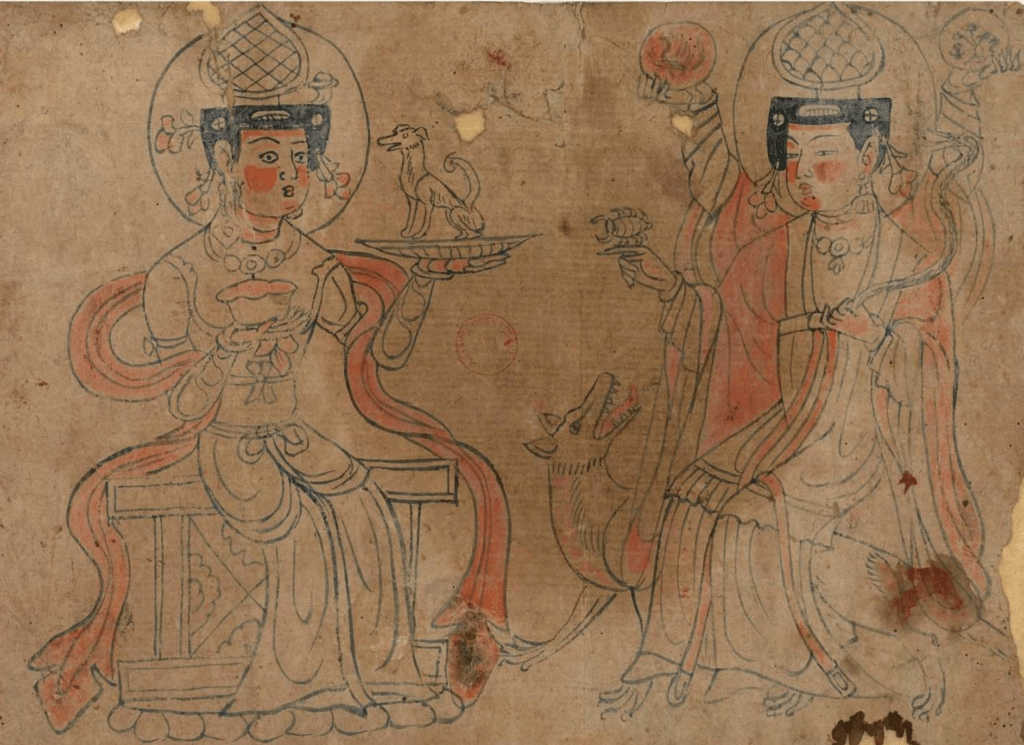
Illustration: a Dunhuang mural depicting a Zoroastrian goddess, now housed in the National Library of France:
0 Kommentare.